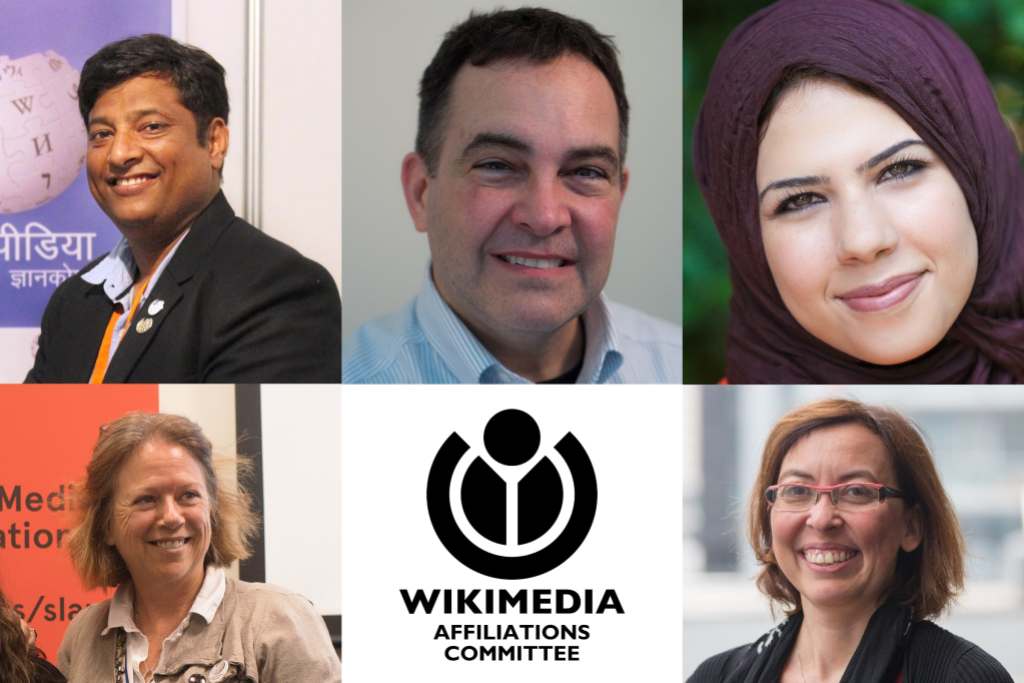
We are happy to share that Başak Tosun, Bunty Avieson, Jeffery Keefer, Ravan Al-Taie, and Suyash Dwivedi are new members who have been appointed to the Affiliations Committee, while Camelia Boban has been re-appointed.
Here are Başak Tosun, Bunty Avieson, Jeffery Keefer, Ravan Al-Taie, and Suyash Dwivedi, in their own words:
Başak Tosun
I have been a contributor to Wikimedia projects since 2005. I mainly contribute to Turkish Wikipedia. For a long time, I was only an online contributor; I discovered that contributions to free knowledge could go beyond editing after I joined an international WikiCamp in 2015. Then I contacted fellow wikipedians to form a user group in Turkey and became one of the founder members of Wikimedia Community User Group Turkey. I took the responsibility of Wikipedia Education Programs in the group and organized Education Programs in several courses at 8 different universities. Additionally, I take part in organising edit-a-thons, partnership search, organising local contests.
Bunty Avieson
I am a media academic at University of Sydney and a member of Wikimedia Australia. I learned to edit at an Art & Feminism event in March 2017 and immediately followed up with an online course. I have since hosted edit-a-thons in Sydney and Bhutan, but my interest goes beyond editing to the larger goals of the Wikimedia movement, particularly around knowledge equity and diversity. I’m currently leading two research projects to build smaller language Wikipedias. One is a collaboration with Tata Institute of Social Sciences in Mumbai to train two groups of retired Tamils, in both Sydney and Mumbai, to edit Tamil Wikipedia. The other is a three-year project funded by the Australian Research Council, to train Bhutanese to publish on both English Wikipedia and also develop their Dzongkha site. I’m an active member of Women Write Wiki and Women In Red.
Jeffery Keefer
I serve as a Wikimedian in Residence for the Patient-Centered Outcomes Research Institute (PCORI). I started editing Wikipedia three years ago while attending an open education conference in London where I went to a workshop and was challenged to learn to try editing Wikipedia. Between then and now Wikimedia has become my online home, where I edit and teach students how to use our Wikimedia projects, am active across all three types of Affiliates, and was one of the writers of the Movement Strategy Recommendations. I have a PhD in educational research. I am or have been involved in a number of Wikipedia + Wikimedia projects across the Movement: Wikimedia Movement Strategy: Integrator, Writer, and Co-Coordinator of the Capacity Building Working Group; Election Facilitator for the Affiliate-Selected Board Seats (ASBS) election, 2019; Member of the Board, Wikimedia New York City; Member, Project Grants Committee; AffCom Reporting Representative, LGBT+ User Group; Member, Editorial Board of the WikiJournal of Humanities; Member, Wikimedians in Residence Exchange Network; Member, Wiki Project Med Foundation Member; WikiConference North America User Group.
Ravan Al-Taie
I am Ravan Al-Taie. I’m the founder of Iraqi Wikimedians User Group. I am an engineer, working as a professional in the Oil industry. I started editing Wikipedia in 2008, edited Arabic wikipedia and became an admin in 2013 for more than 6 years. In 2015, My mother language is Arabic, but I speak Kurdish language fluently as well, that’s why I helped in Kurdish Wikipedia and currently helping other colleagues to correctly start Kurdish Wikipidian user group as per the foundation process because I strongly believe the more diverse we are the best to be in representing the global knowledge heritage. I’ve led several offline activities such as organizing WLM for 3 years in Iraq, as well as starting the first editathon and learning workshop in all Iraq with great success. After that, I’ve focused on bringing more women to the movement in order to decrease the big gender gap that we have in Arabic Wikipedia.
Suyash Dwivedi
I have done my graduation in Electronics Engineering and have been a Wikimedian since 2013. Mostly I edit on Commons, Hindi, English, Wikidata, GLAM, Wikivoyage and sometimes on other Wikipedia projects. I have organized many outreach activities, including conferences and edit-a-thons. I am the founder member of Hindi Wikimedians User Group. Apart from Hindi, I also contribute to English Sanskrit, Marathi, and Punjabi language Wikimedia projects. I was the Lead Organizer of Wiki Loves Monuments 2017 in India, hosted Wikimedia 2030 Movement Strategy Salon in Bhopal, organized Wikipedia Asian Month for Hindi and Sanskrit languages in 2016-2017-2018 and 2019 (for Sanskrit). I have also worked on a short term contract with the Trust and Safety team as ‘Universal Code of Conduct Facilitator’. Currently, I am working on the Internet in a Box (IIAB) hardware to make this device easy to install and control in public places. I also contribute to various other projects like-Creative Commons, ‘Common Voice’ by Mozilla. Raspberry Pi Foundation (JAM organizer), OSM, OpenCon, and Internet Archive. I am volunteering in various UN Environment Programme and campaigns, Google Local Guides (Level 9) and a member of the National Ataxia Foundation.
Please join me in welcoming the newly-appointed members of AffCom.
Respectfully,
Rosie Stephenson-Goodknight (she/her)
Chair, Affiliations Committee
Originally posted by Rosie Stephenson-Goodknight to Wikimedia-l on 12 July 2020.
Can you help us translate this article?
In order for this article to reach as many people as possible we would like your help. Can you translate this article to get the message out?
Start translation